

Priscilla Gonzalez Cost of Living Agenda
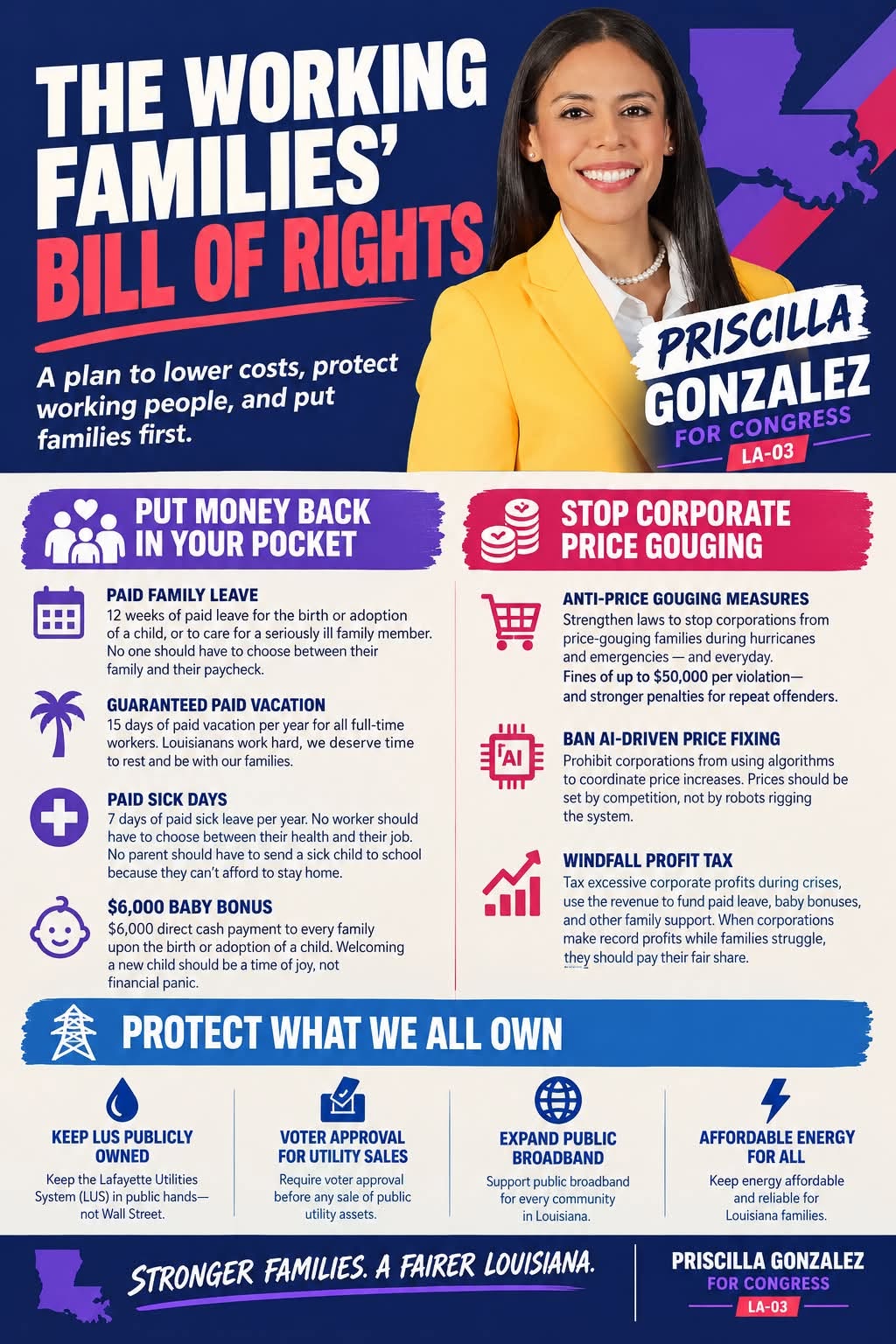
The Working Families’ Bill of Rights
Paid Family Leave
Guaranteed Paid Vacation
Paid Sick Days
Upfront Baby Bonuses
Anti-Price Gouging Measures
Ban AI-Driven Price Fixing
Windfall Profit Tax
Public Ownership of Utilities
The cost of living in Louisiana’s 3rd District has become unsustainable for working families. Wages have stagnated while prices for groceries, rent, utilities and childcare have soared. Parents are forced to choose between staying home with a sick child and losing a day’s pay. Workers go without vacation because they cannot afford unpaid time off. Families are price-gouged during hurricanes and emergencies. Monopolies are using AI to coordinate price increases that squeeze every household in the district.
The Working Families’ Bill of Rights is a comprehensive legislative package designed to address these challenges head-on. It is built on a simple premise: if you work hard and play by the rules, you should be able to afford a decent life. It contains eight provisions, each addressing a distinct dimension of the affordability crisis. Together, they form a coherent agenda for economic dignity and fairness.
Pillar 1: Paid Family Leave
The United States is the only wealthy nation in the world without a national paid family leave policy. In Louisiana, most workers have no legal right to a single day of paid leave after the birth of a child, the adoption of a child, or a serious family medical emergency. Parents are forced to return to work within days of giving birth. Family members cannot take time off to care for a dying parent. Workers who take unpaid leave under the Family and Medical Leave Act often cannot afford to use it.
The Working Families’ Bill of Rights would establish a national paid family leave program, providing up to 16 weeks of paid leave per year for the birth or adoption of a child, the serious illness of a family member, or the worker’s own serious illness. The program would be funded through a modest payroll contribution shared by employers and employees, similar to Social Security, and would be administered through the Social Security Administration to minimize bureaucracy. Benefits would replace a significant portion of wages, with a progressive structure that ensures low-wage workers receive the highest replacement rates. Employers would be prohibited from retaliating against workers who take leave.
No parent should have to choose between bonding with a newborn and keeping their job. No family should have to choose between caring for a sick parent and paying the rent. Paid family leave is not a luxury, it is a basic necessity for working families.
Pillar 2: Guaranteed Paid Vacation
The United States is one of the only industrialized nations that does not guarantee paid vacation time. Roughly one in four American workers receives no paid vacation at all. Even among those who do, many are afraid to use it because of workplace pressure or fear of falling behind. The result is a workforce that is overworked, stressed and less productive than our counterparts in other wealthy nations. In Louisiana, where many workers are employed in low-wage service, agricultural and maritime jobs, paid vacation is often nonexistent.
The Working Families’ Bill of Rights would guarantee a minimum of 15 days of paid vacation per year for all full-time workers, with proportional leave for part-time workers. This would be phased in over several years, starting with 10 days and increasing to 15. Employers would be required to provide vacation time as a legal right, not a discretionary benefit. Workers would be protected from retaliation for using their vacation time, and employers would be prohibited from requiring workers to “use it or lose it” without fair compensation.
Pillar 3: Paid Sick Days
Nearly one in four American workers has no paid sick leave. In Louisiana, that number is even higher for low-wage workers in food service, retail and agriculture. When these workers get sick, they must choose between going to work and spreading illness, deteriorating their physical and mental health or staying home and losing pay or in some cases losing their jobs entirely. During the COVID-19 pandemic, the lack of paid sick leave contributed to the spread of the virus and cost lives. It remains a burden on public health.
The Working Families’ Bill of Rights would guarantee seven days of paid sick leave per year for all workers, accrued at a rate of one hour for every 30 hours worked. Workers would be able to use sick leave for their own illness, to care for a sick family member, or to seek preventive care. Employers would be prohibited from retaliating against workers who use sick leave, and would be required to notify workers of their rights. This policy accompanied by Medicare for All would ensure that there is a healthy population to ensure they can go to work and care for family without the stress of being indebted for life.
No worker would have to pick between their health and their paycheck under the Working Families’ Bill of Rights. No parent should have to send a sick child to school because they cannot afford to stay home. Paid sick days are a matter of public health, economic security and basic human dignity.
Pillar 4: Upfront Baby Bonuses
The cost of raising a child has skyrocketed. Families spend thousands of dollars in the first year alone, on diapers, formula, childcare, medical bills and other essentials. For working families, the arrival of a child can be both a blessing and a financial crisis. Low-income families bear the burden more than the average family. The United States has one of the highest infant mortality rates in the Western world, a direct consequence of our failure to support families.
The Working Families’ Bill of Rights would establish an Upfront Baby Bonus, a direct cash payment of $6,000 to every family upon the birth or adoption of a child. This payment would be made immediately, without bureaucratic delay, and would be available to all families regardless of income. It would be tax-free and would not count against eligibility for other benefits. The payment would be phased in over several years, starting with $3,000 and increasing to $6,000. It would be funded through the Windfall Profit Tax and other progressive revenue sources.
Welcoming a new child should be a time of joy, not a financial panic. The Upfront Baby Bonus is a recognition that raising the next generation is the most important work there is. This platform is pro-choice to support people’s bodily autonomy, this platform is also pro-life because unlike Clay Higgins who would rather babies be born and suffer, I would rather babies be born and thrive.
Pillar 5: Anti-Price Gouging Measures
Price gouging is a fact of life in Louisiana. During hurricanes, evacuations and other emergencies, some businesses raise prices on essentials like water, gasoline, food and hotel rooms to exploit desperate families. Corporations have used inflation as a cover to raise prices on everyday goods, often far beyond their actual cost increase, while reporting record profits. This is exploitation of a captive market and devalues American work while stagnating the economy.
The Working Families’ Bill of Rights would strengthen federal anti-price gouging laws and expand them beyond emergency situations. It would:
Empower the Federal Trade Commission to investigate and penalize price gouging on essential goods during declared emergencies, with penalties of up to $50,000 per violation.
Establish a permanent Price Gouging Watchdog within the FTC to monitor prices for essential goods and services, including food, fuel, medicine and housing.
Require corporations to disclose cost and pricing data for essential goods so that consumers and regulators can identify unjustified price increases.
Create a private right of action allowing consumers to sue companies that engage in price gouging.
Fund state-level enforcement through grants to attorneys general offices in Louisiana and other states.
Pillar 6: Ban AI-Driven Price Fixing
Corporations are increasingly using artificial intelligence and algorithmic pricing tools to coordinate price increases, monitor competitors and maximize profits at the expense of consumers. These tools, sometimes called “algorithmic price fixing” allow companies to raise prices in lockstep without ever meeting or communicating directly. This is a new form of collusion that current antitrust law is not equipped to address. The result is higher prices for everything from groceries to rent to airline tickets.
The Working Families’ Bill of Rights would ban AI-driven price fixing and update antitrust law for the digital age. It would:
Prohibit the use of algorithmic pricing tools for the purpose of coordinating prices, dividing markets or restraining competition.
Require companies to disclose the use of algorithmic pricing tools to regulators.
Create a new division within the FTC dedicated to investigating algorithmic collusion and AI-driven price fixing.
Empower the FTC to levy significant penalties on companies that use AI to fix prices.
Fund research into the effects of algorithmic pricing on consumers and markets.
Protect whistleblowers who report algorithmic price fixing.
Corporate executives should not be allowed to use robots to rig prices against Louisiana families. Whether it’s groceries, rent or utilities, prices should be set by competition, not by algorithms designed to extract every last dollar from working people.
Pillar 7: Windfall Profit Tax
During the inflation crisis of recent years, many corporations reported record profits while raising prices on consumers. Oil and gas companies, food conglomerates and large retailers all benefited from a combination of supply chain disruptions, global instability and opportunistic pricing. These “windfall profits” were not earned through innovation or efficiency, they were extracted from working families during an economic crisis while also claiming tax rebates and corporate subsidies. Meanwhile, these same corporations pay little to nothing in federal taxes.
The Working Families’ Bill of Rights would establish a Windfall Profit Tax on corporations that earn excessive profits during periods of economic disruption or crisis. The tax would apply to profits that exceed a reasonable return on investment, as determined by a formula based on historical profitability and current economic conditions. Revenue from the tax would be used to fund the Upfront Baby Bonus, Paid Family Leave Program and other provisions within the Bill. The tax would be temporary, applying only during periods of declared economic emergency, crisis or during a high inflationary period.
Pillar 8: Public Ownership of Utilities
Utility monopolies have raised rates on families while investing little in modernizing the grid, improving reliability, or transitioning to clean energy. In Louisiana, utility companies have been criticized for poor storm response, inadequate infrastructure and a lack of accountability. Meanwhile, the Lafayette Utilities System, a publicly owned utility that has served the community for over a century, is under threat from privatization efforts that would put profit over people.
The Working Families Bill of Rights would protect and expand public ownership of utilities. It would:
Protect the Lafayette Utilities System from privatization by requiring voter approval before any sale or transfer of public utility assets.
Establish a federal fund to support publicly owned utilities in modernizing their infrastructure, expanding renewable energy and improving reliability.
Empower the FTC to investigate and penalize utility companies that engage in price gouging or unjustified rate increases.
Support municipal broadband and public internet utilities, ensuring that every community has access to high-speed internet at an affordable price.
Create a National Public Utilities Commission to provide technical assistance and oversight to publicly owned utilities.
How We Pay For It
The Working Families Bill of Rights is fully paid for through progressive revenue sources. The total cost of the Bill is estimated at $150 to $200 billion per year, a significant investment in working families, but a fraction of what we spend on unnecessary wars, corporate subsidies and tax breaks for the wealthy.
Funding sources include:
The Windfall Tax
Taxes from the Tax Proposal (Land Value Tax, Wealth Tax)
Financial Transaction Tax on Wall Street Speculation
Savings from ending unnecessary wars and Pentagon waste.
Closing corporate tax loopholes and ending offshore tax havens.
Removing the private sector in the public sector which removes the 3rd party middle man from insurance and instead is directed to the services